Commemoration of the 72nd Anniversary of the Glorious Revolution of 1st November 1954
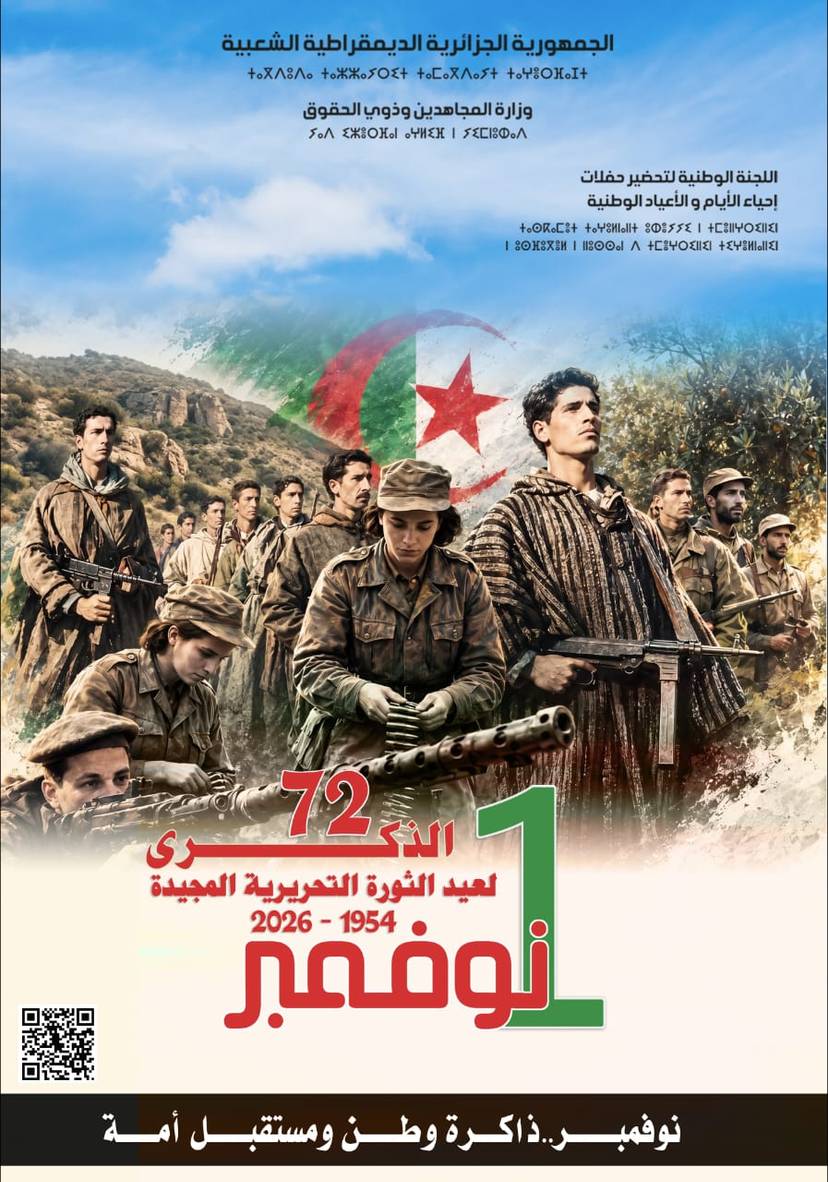
As Algeria proudly and honourably commemorates the 72nd anniversary of the outbreak of the glorious Revolution of 1st November, a defining moment in its history, we stand in profound reverence and humility before the souls of our righteous martyrs, who forged an extraordinary epic of sacrifice and selflessness. This is a landmark occasion on which to reflect upon the course of national liberation, during which the Algerian people, drawing upon all their strength and unwavering resolve, confronted a ruthless French settler-colonial regime in order to reclaim their freedom and sovereignty, whatever the cost.
In that revolution, the Algerian people made immense sacrifices with boundless generosity to recover their usurped land and wrest back their independence, rejecting all attempts to strip them of their identity and erase the foundations of their civilisation.
The glorious Revolution of 1st November was the culmination of decades of popular resistance across our beloved homeland. These included the resistance led by Emir Abdelkader, the resistance of Ahmed Bey, the Zaatcha uprising, the resistance led by Sheikh Boubeghla, the resistance of Lalla Fatma N'Soumer, the revolts led by Sheikh El Mokrani and Sheikh El Haddad, the resistance led by Sheikh Bouamama, and others. It also crowned the struggles of the national movement, which, after many years in which peaceful struggle had proved fruitless, came to recognise the inevitability of armed resistance, particularly following the massacres of 8th May 1945.
On this day, the voice of the free rang out, announcing the outbreak of the liberation revolution. The Algerian people, in all their diversity, across every section of society and every region, answered the call of the Proclamation of 1st November. Every part of the country rose up, sacrificing life and all they possessed under the banner of the National Liberation Front and the National Liberation Army, answering the noble call to armed struggle with the unshakeable conviction that what is seized by force can only be regained by force.
In the wake of the outbreak of the liberation revolution, the ruthless French colonial regime sought to crush it at birth. Its policy soon turned to repression and revenge, relying extensively on brutality, torture, mass extermination, the destruction of villages and hamlets, and the isolation of the population, in a desperate attempt to extinguish the flames of the revolution.
Despite the colonial regime's attempts at retaliation and its efforts to peddle the illusion of victory, the Algerian people stood firm with exceptional courage. This only strengthened their determination and resolve to continue the struggle along the path to freedom and independence. This historic unity of the Algerian people shattered the colonial regime's claims that the revolution was 'merely an isolated uprising' and proved to the entire world that the blessed liberation revolution was a popular choice from which there would be no turning back until full independence and national sovereignty had been achieved.
The French colonial regime realised that even savage military escalation against the Algerians was not enough to overcome their deeply rooted conviction in armed struggle. It therefore resorted to manoeuvres in an attempt to extinguish the flames of the revolution. General de Gaulle called for a 'peace of the brave' and put forward the Constantine Plan, which falsely presented a package of economic and social reforms. Outwardly, the plan appeared to offer appeasement; in reality, it sought to entice the Algerian people away from their leadership and their revolution.
The Algerian people's rallying around the Revolution of 1st November gave the national struggle renewed fervour and brilliance. It drew strength from the 1956 Soummam Congress, which illuminated the revolution's path and represented an organisational, institutional and military turning point, transforming it from a spontaneous uprising into a structured and comprehensive movement.
The revolution gained further momentum from the growing political and diplomatic role played by the Provisional Government, as well as from its resonance and impact on the international stage, which strengthened support for it and solidarity with it around the world. Indeed, its growing prominence contributed to the independence of many colonised countries and encouraged liberation movements across the world to press ahead with their struggles.
Faced with the sweeping military and diplomatic victories of the liberation revolution, France was compelled to sit at the negotiating table. These negotiations culminated in the signing of the Evian Accords. The accords finally formalised Algeria's recovery of its sovereignty and the achievement of its territorial unity, with independence proclaimed on 5th July 1962.
As we commemorate this cherished anniversary, our duty calls upon us to safeguard the legacy entrusted to us by our righteous martyrs and to draw inspiration from the values of November in building the New and Victorious Algeria and strengthening its pride, dignity and standing.
Long live Algeria.
Glory and Eternity to our Valiant Martyrs.